SEO Audit Checklist: 15 Checks You Can Do Today
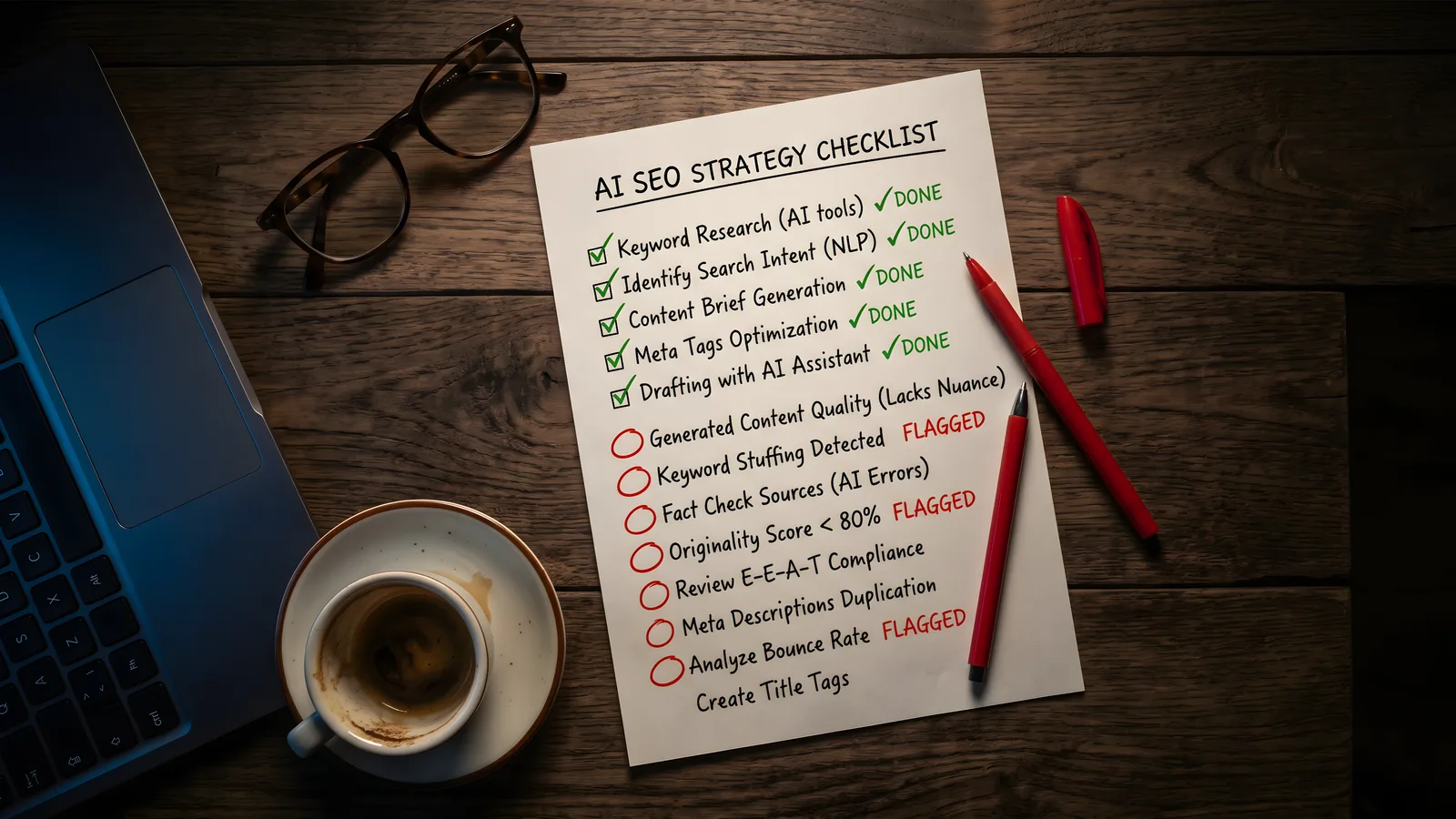
A practical SEO audit checklist covering the 15 checks that catch the most common ranking problems, from titles and indexability to Core Web Vitals and AI crawler access.
New to this topic? Start with SEO for small businesses: ranking higher in Google without an agency
Why an SEO audit?
An SEO audit finds the technical and on-page problems quietly holding your site back, before they cost you rankings. Most sites do not lose positions to a competitor's brilliance, but to broken links, missing titles or pages Google cannot index. This checklist covers the 15 checks that catch the majority of those problems. You can run them by hand, or have a tool do them in one pass.
The 15-point checklist
- 1. Title tags. Every page has a unique, descriptive title of roughly 50 to 60 characters.
- 2. Meta descriptions. Unique, inviting, 150 to 160 characters, no duplicates across pages.
- 3. One H1 per page. One clear H1 matching the page intent, with logical H2 and H3 structure beneath.
- 4. Indexability. No important page accidentally blocked by robots.txt or a noindex tag.
- 5. XML sitemap. A valid sitemap exists, is submitted in Search Console and contains your real URLs.
- 6. Broken links. No 4xx or 5xx links, internal or external, sending users and crawlers to a dead end.
- 7. Redirect chains. Redirects go straight to the destination, no long chains or loops, and HTTP goes to HTTPS.
- 8. Core Web Vitals. LCP, INP and CLS are green on mobile and desktop.
- 9. Mobile friendly. The site is responsive and readable on a phone, Google indexes mobile-first.
- 10. HTTPS. The whole site is secure, with no mixed content loading over http.
- 11. Canonical tags. Correct canonicals prevent duplicate content confusion.
- 12. Structured data. Article, FAQ, Product or Organization schema where relevant, valid and error-free.
- 13. Image optimisation. Descriptive alt text, modern formats (WebP or AVIF) and sensible file sizes.
- 14. Internal links. Important pages are linked from other relevant pages, not orphaned.
- 15. AI crawler access. The search bots of AI assistants (OAI-SearchBot, Claude-SearchBot, PerplexityBot and Googlebot) are allowed, in robots.txt and in your firewall or CDN, so you can show up in AI answers (GEO).
Which four to do first
Tackling fifteen points at once is an afternoon of work whose effect you cannot see. Four of them account for most of the damage.
Indexability (4) comes first because it is binary. A page accidentally set to noindex ranks for nothing, whatever is on it. This is the only check where one mistake wipes out all your effort on a page, and it takes ten minutes to verify.
Broken links (6) cost you not only visitors but the internal link value you carefully built. A link to a deleted page is effort thrown away.
Title tags (1) are the cheapest win available. A page with no title or a duplicate title competes with itself; that is fixable with one line of text.
AI crawler access (15) sits fourth because the error is invisible. You notice nothing, your rankings hold, and meanwhile you do not appear in the answers more and more people are reading.
What an audit does not tell you
Here sits the biggest misunderstanding about technical audits. A clean audit does not mean you will rank.
Fifteen green ticks say there is no technical obstruction. They say nothing about whether your content beats the number one, whether your subject is covered, or whether anyone links to you. Technical work releases the brake; it does not push.
The reverse does hold: a technically broken site cannot make up for it with good content. That is why an audit is the first step and not the whole strategy.
How often to do this
Once a quarter is enough for most sites, with two exceptions.
After a migration or a redesign, do it immediately. That is the moment redirects, canonicals and indexability go wrong at scale, and where recovery is most expensive if you let three months pass.
And for a site that changes often, such as a web shop where products come and go, monthly is more realistic. Every removed product page is a potential broken link elsewhere.
Common mistakes
- Fixing symptoms, not causes. A dropped ranking is often a technical problem, not a content problem.
- Auditing once and never again. Sites decay: new pages break rules, links rot, speed slips.
- Ignoring AI crawlers. Blocking them quietly removes you from AI search.
A fourth that comes up often: wanting to fix everything at once. A list of eighty findings is paralysing. Sort by severity, take the first ten, and run the audit again. What remains is usually half, because many findings share one cause.
What it gets you
Be realistic about the return. Technical fixes rarely produce a jump; they remove a brake.
What you can expect: pages that were not indexed enter the index within weeks, click-through rates rise noticeably on better titles, and the speed gain from optimised images shows straight away in your Core Web Vitals.
What you should not expect: a jump from page three to page one on a competitive keyword. That takes content and authority, see building topical authority.
Do it automatically
15 checks by hand across a whole site is slow, and it is out of date the moment you finish. The dGENIX SEO Engine runs this as a real multi-page crawl (100+ checks), reruns on a schedule, and writes paste-ready fixes for what it finds. GENI can notify you the day a ranking drops. Learn the full workflow in AI SEO in 2026.
Get a free audit of your site in a minute, or create a free account.