Local SEO in Nijmegen: get found in Google and AI search
The oldest city in the Netherlands, with a university, a strong medical cluster and an entirely new district across the river. Here is how you get found here.
New to this topic? Start with How to get found locally in the Netherlands: the complete guide
Why local visibility in Nijmegen matters
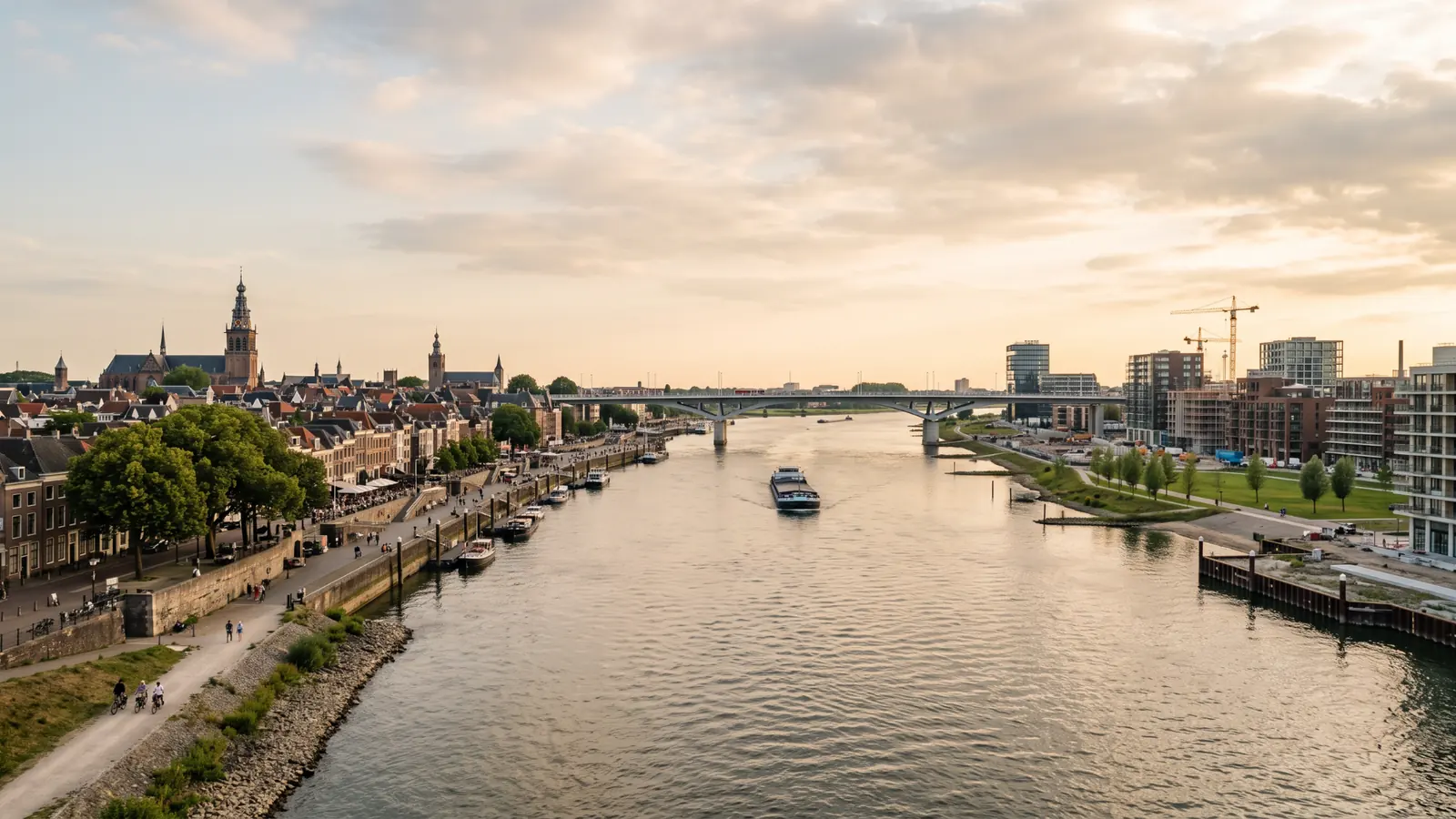
Nijmegen is the oldest city in the Netherlands and at the same time one of the fastest changing. South of the river Waal lies a compact, historically grown city with a university, an academic hospital and a large student population. North of it lies the Waalsprong, an area that went from farmland to a full city district in twenty years and is still building.
That split makes the search market interesting. In the old part you compete with businesses that have been there for a long time and built a name. In the new part live tens of thousands of people who had to look everything up again and where an established name barely exists. For many sectors the easiest gains therefore lie literally on the other side of the river.
What do people search for in Nijmegen?
"doctor Nijmegen-Oost", "hairdresser Bottendaal", "physio Lent", "dentist Dukenburg" or "contractor Waalsprong". What stands out is how often people use the neighbourhood name here: residents identify strongly with their district, and you see that back in what they type.
The neighbourhoods differ considerably. Nijmegen-Oost and Hunnerberg are green and affluent, Bottendaal and the centre are urban and young, Dukenburg and Lindenholt are postwar districts on the west side with their own shopping centre, and Lent, Oosterhout and Ressen together form the Waalsprong with many young families in new-build homes.
What works in Nijmegen
- Target the neighbourhoods. Nijmegen-Oost, Bottendaal, Dukenburg and Lent are separate search markets with their own audiences. See Finding local keywords.
- Treat the Waalsprong as its own market. Lent and Oosterhout have few established providers and many new residents without a fixed preference. That is the lowest barrier in the whole city.
- Optimise your Google Business Profile. In a compact city with many similar providers the map is the fastest way to stand out. See Optimizing your Google Business Profile.
- Be visible to AI. A large student population and a highly educated population use AI assistants above average. Read Local visibility in AI search.
- Collect reviews. In a city where people recommend each other a lot, reviews confirm online what people already hear offline. See Getting more Google reviews.
Per sector: where the wins are
Care and medical. Around the academic hospital and the university sits an exceptionally strong medical cluster. For practices, therapists and specialised care providers that means a critical audience that searches and compares thoroughly. Substantive pages explaining exactly what you treat weigh heavily here.
Hospitality and retail in the centre. A large student population and a lively city centre create an audience that searches fast and on mobile, reads many reviews and writes them too. Current opening hours and fresh photos are not a side issue here.
Sustainability and engineering. Nijmegen has profiled itself on sustainability for years, and that translates into real demand: insulation, heat pumps, solar panels and retrofitting existing homes. Whoever offers that and writes well about it finds a receptive market.
Construction and services in the Waalsprong. Thousands of homes from around the turn of the century and later are now entering the phase where gardens, extensions and maintenance come into play. The residents are young, digital and look everything up online.
Frequently asked questions
Is Lent part of Nijmegen or a separate market? Administratively it belongs to Nijmegen, but as a search market it behaves like its own town. People type "Lent" and not "Nijmegen" when they live there, and competition on those words is a fraction of that in the centre.
How important are students for my business? That depends strongly on your sector. For hospitality, hairdressers and gyms it is a load-bearing market, for construction and professional services hardly at all. Choose deliberately instead of half serving both.
A concrete example
Say you run a physiotherapy practice in Nijmegen-Oost and want to grow. On "physiotherapist Nijmegen" you compete with the whole city, including practices tied to the hospital. Build an additional page aimed at Lent and you reach a district full of young families where supply is still thin and almost nobody targets specifically. You set your business profile to your location, state clearly on your site which neighbourhoods you serve and what you specialise in, and ask for a review after each course of treatment. That way you hold your position in your own district and capture the growth market across the river at the same time.
How to start in Nijmegen
- Pick your neighbourhood, such as Nijmegen-Oost, Bottendaal or Dukenburg, and start there instead of city-wide.
- Build a separate page for the Waalsprong if you can serve customers there, because the barrier is lowest.
- Get your Google Business Profile fully in order, including current opening hours and photos.
- Collect reviews consistently, certainly in care and services where trust decides.
- Measure your positions and your AI visibility, and expand once a district starts to run.
One more frequently asked question
The Waalsprong is still growing, is it too late to start? No, and that is down to the nature of the area. Homes are still being delivered and new residents keep arriving with no local preference at all. On top of that the first residents are now moving into the life stage where they renovate, extend and buy more services than at delivery. Whoever builds a clear page for it now and sets their service area properly steps in exactly when demand per household is increasing.
Visibility as an advantage in Nijmegen
Nijmegen rewards businesses that choose. The old city is compact and competitive, with providers who have held a name for decades, while on the north side stands an entire district where that history simply does not exist. Whoever builds visibility per neighbourhood instead of city-wide can defend what they have in one part and build what is not yet there in the other. That is a considerably cheaper way to grow than trying to rank first everywhere at once.
How dGENIX helps
The SEO Engine, the GEO Engine and the Reputation Engine measure, improve and collect together. GENI runs it and keeps it up on a fixed schedule, so you keep both your own neighbourhood and the growth areas in view.
This belongs to our guide Getting found locally in the Netherlands.
Want to see how you rank in Nijmegen? Run a free SEO and GEO scan. Or join the waitlist.